
How to Choose the Right Disperser Machine for Paint Manufacturing


Choosing the right disperser machine is an important decision for any paint manufacturing plant. The machine affects pigment dispersion, batch time, product consistency, power consumption, and overall production capacity.
A disperser that works well for one paint formulation may not be suitable for another. Factors such as batch size, viscosity, pigment type, blade size, speed, and motor power all need to be considered.
This guide explains the key points to check before selecting a disperser for paint manufacturing.
What Is a Disperser Machine for paint manufacturing?
A disperser machine is used to mix and disperse materials such as pigments, fillers, resins, solvents, and additives.
In paint production, the main purpose of a high-speed disperser is to break down pigment agglomerates and distribute the particles evenly throughout the liquid.
A typical disperser consists of:
Electric motor
Shaft
Saw-toothed Cowles blade
Lifting mechanism
Mixing vessel
Control panel
Hydraulic or mechanical lifting system
The blade rotates at high speed and creates strong movement in the batch. This helps wet and break down pigment particles and produce a more uniform mixture.
1. Start With Your Batch Size
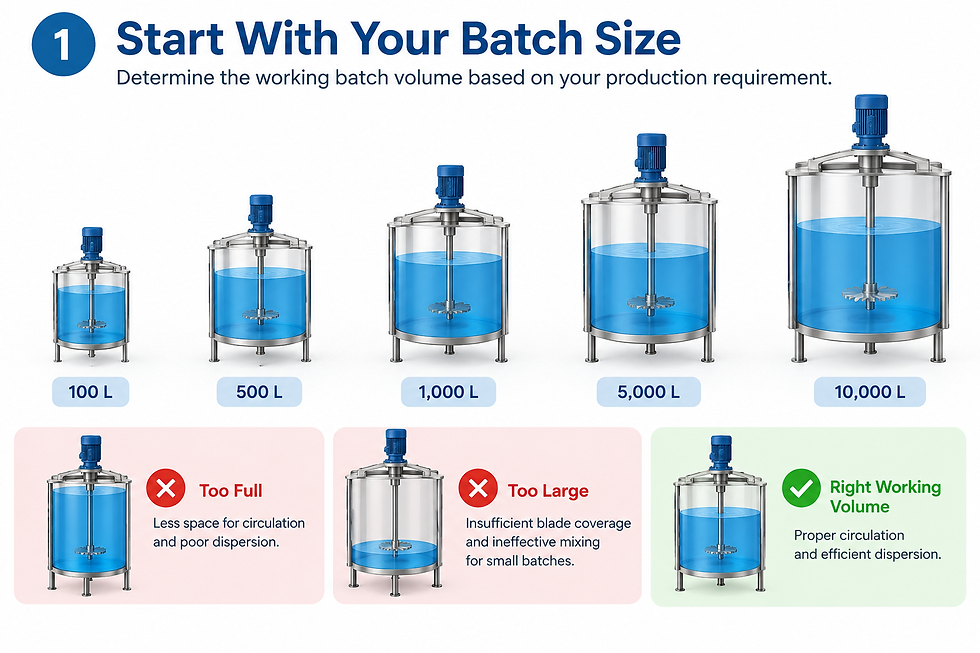
The first step is to determine the working batch volume.
For example, a plant may require:
100 litre batches
500 litre batches
1,000 litre batches
5,000 litre batches
10,000 litre batches
The machine should not simply be selected based on the total tank capacity.
The working volume is more important because the product needs enough space inside the vessel for proper circulation and dispersion.
A tank that is too full can reduce circulation, while a tank that is too large for a small batch may not provide effective blade coverage.
2. Consider the Viscosity of the Product

Viscosity describes how easily a material flows.
Water has low viscosity, while products such as high-solids coatings, putty compounds, and heavy pastes have much higher viscosity.
As viscosity increases, the disperser generally needs more power to maintain effective movement.
Therefore, motor selection should consider:
Batch size + viscosity + formulation + required dispersion intensity
Do not select motor power based on batch volume alone.
Two products made in the same 1,000-litre vessel can require very different motor powers if their viscosities are different.
3. Select the Correct Disperser Blade

The blade is one of the most important parts of a high-speed disperser.
A saw-toothed Cowles blade is commonly used for pigment dispersion because its teeth create strong local shear and help break down pigment agglomerates.
Blade diameter must be selected according to:
Tank diameter
Batch volume
Product viscosity
Required dispersion intensity
Operating speed
A blade that is too small may not circulate the complete batch effectively.
A blade that is too large may require excessive power and can create unnecessary load on the motor.
4. Understand Tip Speed

RPM alone does not tell you how aggressively a disperser is operating.
The tip speed is the linear speed of the outer edge of the disperser blade.
It depends on both the blade diameter and rotational speed.
A commonly used calculation in feet per minute is:
Tip Speed (FPM) = RPM × 0.262 × Blade Diameter (inch)
For example, consider a 20-inch blade operating at 1,000 RPM:
Tip Speed = 1,000 × 0.262 × 20
Tip Speed ≈ 5,240 FPM
Increasing RPM or blade diameter increases tip speed.
However, higher tip speed does not automatically mean better dispersion. The correct operating speed depends on the formulation, viscosity, pigment type, blade design, and process requirements.
5. Check the Motor Power

Motor power needs to match the load placed on the disperser.
If the motor is undersized, the machine may struggle when processing high-viscosity material. This can result in:
Longer batch times
Motor overload
Reduced production
Poor circulation
Higher operating stress
On the other hand, using a much larger motor than necessary can increase equipment and operating costs.
The ideal motor is one that can provide the required power while maintaining reliable operation under the expected process conditions.
6. Look at the Tank-to-Blade Relationship
The position of the blade inside the tank also affects dispersion.
The blade needs to be positioned so that the material moves effectively through the vessel rather than simply rotating around the blade.
Important factors include:
Tank diameter
Liquid height
Blade diameter
Blade position
Tank bottom shape
Product viscosity
Correct blade positioning helps create better circulation and reduces areas where material can remain stagnant.
7. Consider the Type of Paint You Manufacture
Not every paint formulation behaves in the same way.
For example, the requirements for:
Architectural paints
Industrial coatings
Automotive coatings
Primers
Printing inks
Pigment concentrates
Putty
High-solids coatings
can be different.
The required dispersion intensity, motor power, blade design, speed, and processing time should therefore be selected according to the actual product.
8. Variable Speed Can Improve Process Control
A variable-speed drive can give operators greater control over the dispersion process.
Different stages of production may require different speeds.
For example:
Stage 1 — Wetting
The pigment and liquid are combined at a controlled speed.
Stage 2 — Dispersion
Speed can be increased to provide the required dispersion force.
Stage 3 — Final Mixing
The speed can be adjusted to maintain uniformity while avoiding unnecessary air entrainment.
This flexibility can be useful when one machine is used for several different formulations.
9. Don't Ignore Air Entrapment
Running a disperser too aggressively can sometimes pull air into the product.
Air entrainment can cause:
Foam
Bubbles
Poor appearance
Filling problems
Longer deaeration time
The goal is not simply to operate at the highest possible RPM.
The goal is to achieve the right balance between shear, circulation, dispersion and air control.
10. Think About Future Production
When purchasing a disperser, consider not only today's production requirements but also future needs.
Ask:
Will batch sizes increase?
Will new products be introduced?
Will viscosity change?
Will the machine process different raw materials?
Will production volume increase?
Selecting equipment with appropriate operating flexibility can prevent the need for an early replacement or major modification.
Common Mistakes When Selecting a Disperser
Some common mistakes include:
Selecting the machine only by tank capacity
A 1,000-litre machine does not automatically mean it can process every 1,000-litre product effectively.
Selecting motor power only by batch size
Viscosity and formulation can significantly change the power requirement.
Focusing only on RPM
RPM does not tell the complete story. Blade diameter and tip speed also matter.
Using the wrong blade
Different applications may require different blade designs and sizes.
Running at maximum speed all the time
Maximum speed is not always the best operating condition.
Ignoring future requirements
A machine selected only for today's production may become a limitation as production increases.
The Right Disperser Is a Process Decision
Selecting a disperser is not simply about choosing a motor and tank of a particular size.
A properly designed system considers the complete process:
Product → Batch Size → Viscosity → Blade → Tip Speed → Motor Power → Tank Geometry → Mixing Time
When these factors are correctly matched, the disperser can provide more consistent dispersion, reliable production, and better process control.
For paint manufacturers, the right machine should be selected based on the actual formulation and process requirements, rather than using a one-size-fits-all approach.
Final Thoughts
A high-speed disperser is often one of the most important machines in a paint manufacturing line. Its performance can directly affect the quality and consistency of the finished product.
Before selecting a machine, carefully evaluate your batch size, viscosity, pigment system, blade diameter, tip speed, motor power and required production time.
A well-matched disperser can help achieve consistent dispersion while reducing unnecessary processing time and equipment stress.
Chem Maco has been designing and manufacturing industrial mixing and dispersion equipment since 1971, serving applications across paint, chemical and allied industries.


Comments